The Enigma Thesis: Emission In, IP Out, Royalties In
Straight answers on the Enigma business model: what collaborators are for (and when a challenge doesn't need one), who actually pays for the IP, how emission becomes a portfolio that pays royalties back into the subnet, the ladder we're climbing rung by rung, and why prize caps move the flywheel.
Straight talk on the strategy.
We got asked a hard question recently, and it deserves a straight answer:
What is Enigma actually selling? If the collaborators aren't the ones licensing the IP, what are they for? What happens to a challenge that has no collaborator at all? And who actually pays for any of this?
Fair questions, and they deserve answers in order. Here's the model, no fluff. It's a vision, not a promise. But we believe in it, and we'd rather show you the whole thing than feed you the safe parts.
What Enigma Is Actually Selling
Enigma is a challenge platform on Bittensor. We take emission, turn it into serious prize pools, and point them at questions the world needs answered: can RSA really be broken, and at what cost? Can a quantum scheme survive contact with the sharpest attackers alive? The world competes in the open, winning solutions get published, and the difficulty ratchets up until something extraordinary gives.
That produces two things of value. The first is truth: public, adversarial proof of what breaks and what survives, worth real money to anyone building on these technologies. The second is IP: every winning solution is published under a viral license, and we keep the commercial rights. Open science for the world, a licensable portfolio for the subnet.
Hold that frame. The rest of the answers fall out of it.
What Collaborators Are For
It's a trade. Every collaborator signs up for two jobs: help us design the challenge right, and promote it with their reach.
What do they get? The truth. If you're building on a technology, you need to know if it breaks. The cheapest, most credible way to find out is to put a bounty in front of the smartest people on earth and let them attack it in public. Survive, and you have a benchmark money can't buy. Break, and you found out before an adversary did. Either way they win. That's why serious companies are showing up.
What do we get? Their reach. Their platforms put our challenges in front of the people who can actually produce breakthroughs — researchers, cryptanalysts, quantum teams who have never touched Bittensor. It finds the people who can build the breakthroughs, and it tells the world those breakthroughs exist.
Notice what's not in the trade: any obligation to license. The collaborator's payoff is the truth about their technology and the visibility of sponsoring the hunt. The licensing market is much bigger than them. AGPL is aggressive on purpose: build these breakthroughs into your product and the license obliges you to open-source the entire system you built on top of them, even if you only ever serve it over a network. For virtually every commercial company on earth, that's a non-starter. Their only other door is a commercial license, and we're the ones standing in it. That market might include the collaborator someday. It might be a company that has never heard of us today. The IP engine doesn't depend on which. Who actually pays, and how the money moves, is the engine below.
What About Challenges With No Collaborator?
First, the aim. It isn't to do this without collaborators. It's that they can't be a requirement for every challenge, because right now, finding serious companies willing to put up with crypto and Bittensor is a limiting factor on how fast we can scale. We needed collaborators early. We benefit from them anytime. But we can also run without them.
Run a challenge bare and we lose exactly two things: their reach and their technical oversight. Neither is fatal.
Reach, we're building our own. Every challenge that lands makes the next one easier to launch bare, because the audience that watched the last solve is already here. Popularity compounds.
Technical depth, we can get plenty of other ways: our own team, advisors, the published literature, and the solver community itself, which by now includes some of the sharpest people in these fields.
The honest rule of thumb: the less central a challenge is to what we do, the more a collaborator matters. Quantum and cryptanalysis are home turf; we can run those bare. The further we range from home, the more we want a partner who lives there.
The real difficulty with collaborators isn't finding a reason for them. It's that a volatile ecosystem makes those relationships hard to manage. A serious company signs up for a challenge measured in months, and the ground under it, price, emission, politics, can shift in a week. That one's on us. And it's one more reason the disciplined tokenomics matter: stability is a business development asset.
Emission In, IP Out, Royalties In
We've been too quiet about this part: Enigma's product isn't the challenge. It's the IP the challenge produces.
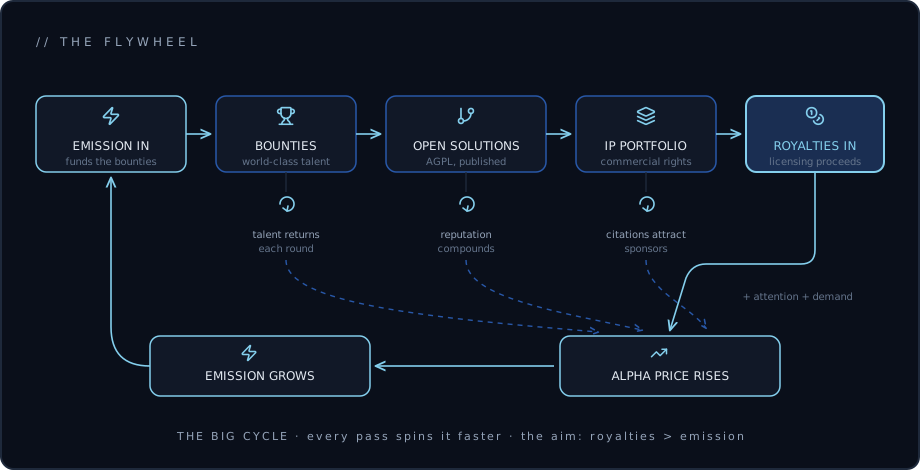
- Emission funds bounties big enough to be worth a world-class team's time.
- Bounties pull in outside innovators. Nobody leaves a research lab to mine a commodity subnet. They will absolutely chase a famous problem with real money on it.
- Winning solutions get open-sourced under AGPL. The science is public. Read it, verify it, build on it, in the open.
- Want to use it without open-sourcing everything you build on top of it? The license doesn't give you that option. You need a commercial license, and we're the ones who grant it.
- Royalties from those licenses come back into the subnet. That's the loop: emission funds the work, the work becomes IP, the IP pays royalties, the royalties flow back in — with the aim of one day outpacing the emission itself.
- Every solution compounds: papers, citations, reputation. Each one makes the next collaborator easier to sign and the next innovator easier to attract.
One loop undersells it. There are micro-loops running inside one big cycle. Talent that competes once comes back for the next challenge. Reputation from each solved milestone makes the next collaborator cheaper to sign. Citations pull in sponsors. And the whole flywheel, the results and the attention and the royalties, drives demand for the subnet's alpha, which drives the price, which drives higher emission, which funds bigger bounties. Every pass spins it faster.
Breaking RSA already proved the front half of the loop: an outside team built a from-scratch GPU siever that factored a 500-bit modulus in under four hours on a single node. Open-sourced, published, watched. The back half of the loop — licensing revenue — is the long game.
The Ladder
The whole climb, and where we stand on it. We'll keep reporting our position honestly, in both directions.
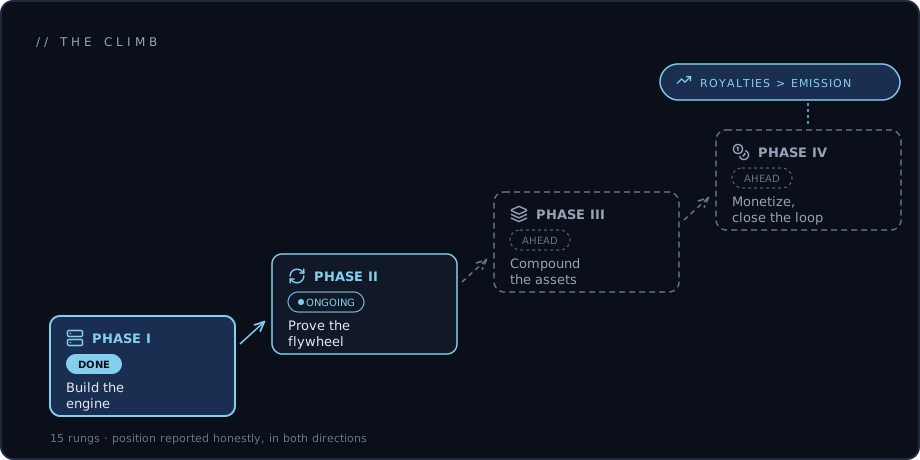
| Phase | Focus | Rungs | Status |
|---|---|---|---|
| I | Build the engine | 1–3 | DONE |
| II | Prove the flywheel | 4–8 | ONGOING |
| III | Compound the assets | 9–12 | AHEAD |
| IV | Monetize and close the loop | 13–15 | AHEAD |
Phase I — Build the engine
- Build the platform — done
- Launch seed challenges — done
- Attract industry collaborators — done
Phase II — Prove the flywheel
- Use collaborator reach to promote the subnet — ongoing
- Use collaborator reach to pull in outside innovators — ongoing
- Produce novel winning solutions — done, repeatedly
- Package the portfolio so the field can actually use it — open archives, whitepapers, benchmarks — ongoing
- Expand the challenge portfolio, so one engine runs many experiments at once — ongoing
Phase III — Compound the assets
- Produce a revolutionary solution — one that moves a field, not just a leaderboard
- Earn citations in industry and academic reports
- See our code land inside open-source libraries under viral licensing
- Field inbound challenges — sponsors coming to us and funding pools with their own money, because the signal is worth paying for
Phase IV — Monetize and close the loop
- Grant the first commercial license
- Make licensing repeatable — a portfolio that fields requests, not a one-off
- Route the royalties back into the subnet — licensing proceeds flowing in, with the aim of one day outpacing the emission flowing out
Six months ago everything in Phase I was unproven. Today it's behind us and Phase II is compounding. Phase III is where the long game gets decided. Phase IV is the destination, and the final rung on the ladder is the whole point: emission in, IP out, royalties in.
The day royalties outpace emission is the day a subnet stops being funded by its holders and starts funding them. Nobody on Bittensor has done it. We'd like to be among the first.
Watch step 12. Licensing is the moonshot, but inbound sponsor-funded challenges are the nearer milestone that changes the economics on their own. Every challenge a sponsor funds reduces Enigma's reliance on emission and serves as direct market proof that what we produce is worth real money.
Why Prize Caps Move The Flywheel
The per-challenge caps we announced aren't discipline for its own sake. They rewire our own incentives, on purpose, starting with the one that keeps us honest:
- Caps drive urgency: If a pool fills, the overflow burns, and burning kills our emission. That's the design working: pay out real prizes for real breakthroughs, or watch the engine starve. We don't get to sit on a vault.
- Caps align incentives: With pools bounded in alpha, the only way to pay out larger prizes is to make the alpha worth more: drive the value of TAO and the subnet higher. So that's what we work toward. Same direction as every miner, validator, and holder.
- Caps drive depth: To be worthy of a bigger prize, a milestone has to be harder, more extraordinary. Bounded pools push the challenges up the difficulty curve.
- Caps drive breadth: The way to grow what the engine can accumulate is to open more challenges. More concurrent challenges, more shots at the revolutionary result, and no single bet carrying the whole thesis.
The tokenomics changes and the IP thesis aren't two separate stories. The caps are what force the flywheel to spin.
Something People Don't Say
Most subnets spend emission as a cost of delivering a service. That can produce real revenue. But when emission subsidizes the service, the economics scale with the emission. Revenue, yes. Standalone profit? Somewhere between "mathematically impossible" and "brutally hard". Our math says it can't happen.
Enigma spends emission as investment. Bounties buy assets: an IP portfolio, a citation trail, a reputation as the place hard problems get solved. Assets can pay you back independent of the emission that bought them.
And the part nobody wants to admit: no subnet on Bittensor has ever delivered mathematical profitability. Not one. Ours included. (Tell us if we are wrong.) Alpha prices today run on sentiment and speculation. Nothing else is in there. We're not pretending we've escaped that. We're saying we're one of the few running a model with a credible path out, and we just showed you every step of it.
What If We're Wrong?
Maybe the licensing endgame never lands. That's real, and we'd rather say so up front than sell you certainty. If the moonshot misses, the base case still stands on its own: hard challenges, world-class talent, open science, bounded pools, and the attention real breakthroughs earn.
But watch the pattern before you bet against it: collaborators keep engaging, outside talent keeps showing up, novel solutions keep landing. Every rung we climb makes the next one easier to reach.
Come shoot at it
Promises don't earn conviction. Showing the why and the how, and letting people take shots at it, does. So here it is. If you see a flaw in the model or a rung we're missing, come tell us. In the meantime, we'll keep showing our work.