Hardening Quantum Proof: A Tale of Two Solvers
Milestone 3 of Hardening Quantum Proof was broken by two independent solvers within hours of each other. Here's what happened, what was achieved, and what this means for Enigma.
In late June, we released the third milestone of Hardening Quantum Proof, a challenge focused on breaking peaked circuits in collaboration with BlueQubit.
For nearly three months, the milestone remained unbroken, allowing the prize to rise from $10,000 to $27,500.
Then all of a sudden, submissions skyrocketed and within days, the milestone was broken.
Here's the story of what happened, what was achieved, and what this means for Enigma.
What Is Hardening Quantum Proof?
Quantum computing has a trust problem.
Say a company tells you their machine just ran a calculation no classical computer could handle. How do you check? You can't just run it yourself; that's the whole point. It could be genuine quantum hardware. It could be a classical simulator. It could be broken hardware returning noise.
Peaked circuits are BlueQubit's proposed answer. A peaked circuit is a quantum program embedded with a hidden bitstring -- the kind of circuit that is trivial for a real quantum computer to execute but near impossible to simulate (in theory) on a classical computer. At Milestone 3's size, there are up to 72 quadrillion possible outputs to search.
If this holds, peaked circuits become a quantum proof: a quick, checkable test that a machine is really doing quantum computation.
If it doesn't hold, someone needs to find out before it becomes used in critical infrastructure.
That's the challenge. BlueQubit, one of the leading experts on peaked circuits, designs them. Enigma, our challenge platform on the Bittensor network, pays anyone who can find the peak using only classical hardware.
Every break shows exactly where the proof is weaker than assumed. BlueQubit hardens the design, and the next milestone opens. Every hold is evidence the design is getting stronger. Either way, the field learns something it didn't know before.
Why Milestone 3 Was Different
On their own, peaked circuits are fairly trivial to simulate classically. BlueQubit increases the difficulty of their peaked circuits by padding the middle of them with obfuscation blocks. These blocks are composed of a random circuit followed by its inverse, creating a computationally expensive identity block. The structure of this identity block is obfuscated with a set of operations that sweep, mask, and swap qubits, making it difficult to detect.
In April, researchers at IBM published a method that exploits the structure of these obfuscation blocks. It works through the circuit from the middle outward so the padding's two halves cancel, and strips out the hidden qubit shuffles as it goes. IBM predicted that adding more obfuscation would make this attack more expensive, but wouldn't close the underlying gap. Earlier Enigma winners built on the same ideas to clear Milestones 1 and 2 within the challenge's first few weeks.
Milestone 3 put IBM's prediction to the test. Its circuits have 48–56 qubits and over 1,400 two-qubit gates, roughly twice the size of Milestone 1, with more obfuscation layered through them to hide the structure further.
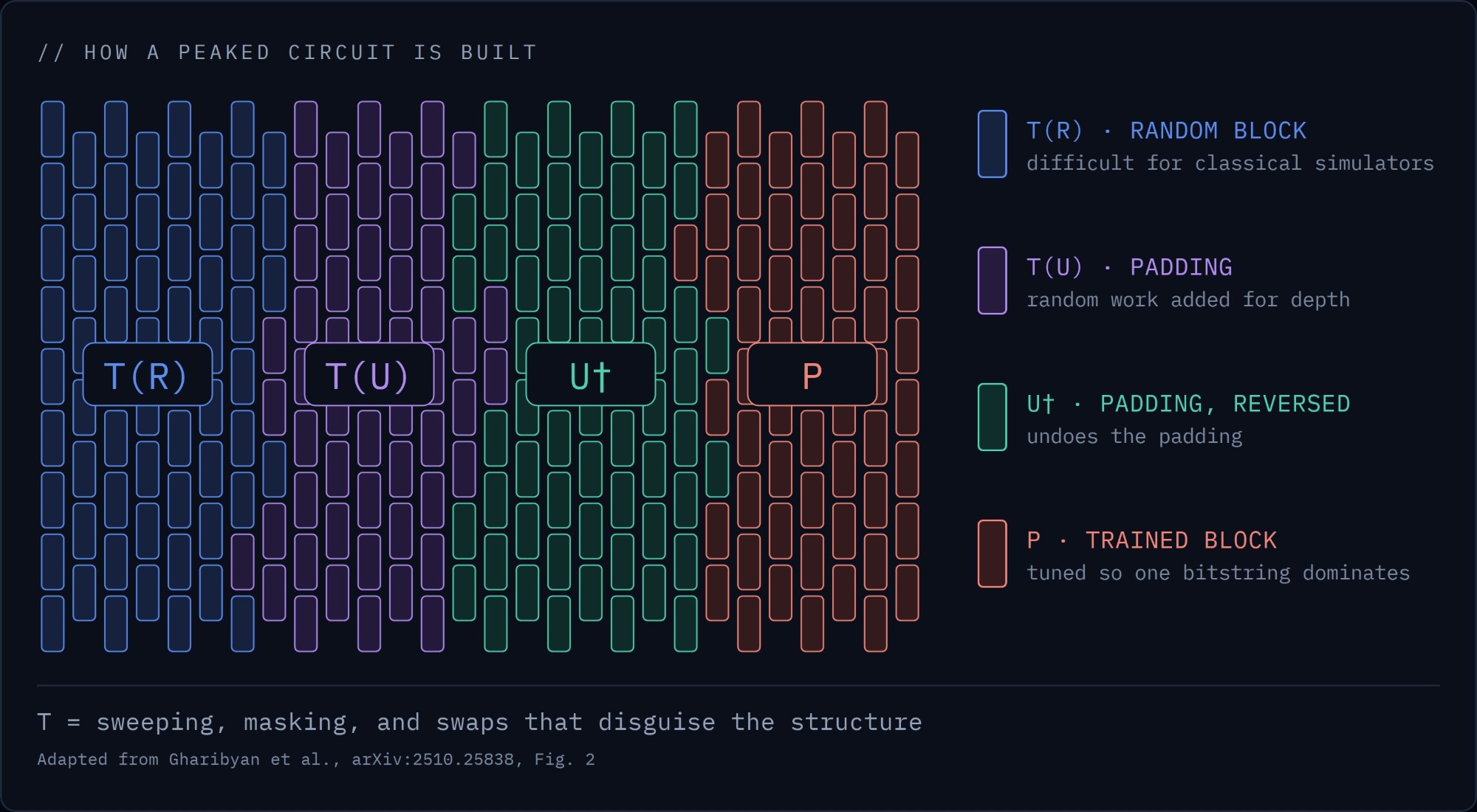
How a peaked circuit is built. Adapted from Fig. 2 of Gharibyan et al., "Heuristic Quantum Advantage with Peaked Circuits," arXiv:2510.25838 (2025).
The Race To The Finish
For months, the milestone held strong against the barrage of submissions, with most barely scratching the surface of what was required to win.
This was the kind of milestone that BlueQubit described to us as one that "quantum experts would find challenging".
Then suddenly, we saw a surge in submissions -- not one, but two miners were racing to the finish, battling to be the first to claim the grand prize.
After two hard-fought days, one miner emerged victorious.
Just hours later, the second miner crossed the finish line as well.
The Payout
What was more remarkable than the fact that the milestone was solved by two miners within hours of each other was that their solutions took their own unique approaches to exploiting the mirror structure of the obfuscation blocks.
Enigma milestones are of course winner-take-all, so the first solver receives the full $27,500 prize.
But the second solution still has real value and reveals an attack vector that's just as important.
A second independent method is exactly what BlueQubit needs to harden the next design, and it serves as an entirely different piece of IP.
To make sure that this IP sees the light of day, we've issued a one-time $10,000 award to the runner-up in exchange for open-sourcing their solution.
Two Solvers, Two Routes Past the Same Weakness
Both solvers started from the published work of IBM and our previous milestones, but took it in their own direction.
The first miner took a surgical approach. They worked out that each of the extra obfuscation blocks, however complex it looks, amounts to little more than a reshuffling of the qubits. So they found each block, cut it out, replaced it with its reshuffle, and measured and put back the small leftover. That turned a Milestone 3 circuit back into a basic peaked circuit, which known methods solve quickly. They also found a faster way to run the cancellation itself, and required several independent calculation methods to agree before submitting.
The second solver took a search-based approach. They found the two main obfuscation modules by spotting gates that exactly undo each other. Then they ran the cancellation starting from one module and working towards the other, hunting for the point where the calculation collapsed into something small. From there, they rebuilt a much shorter circuit and solved that.
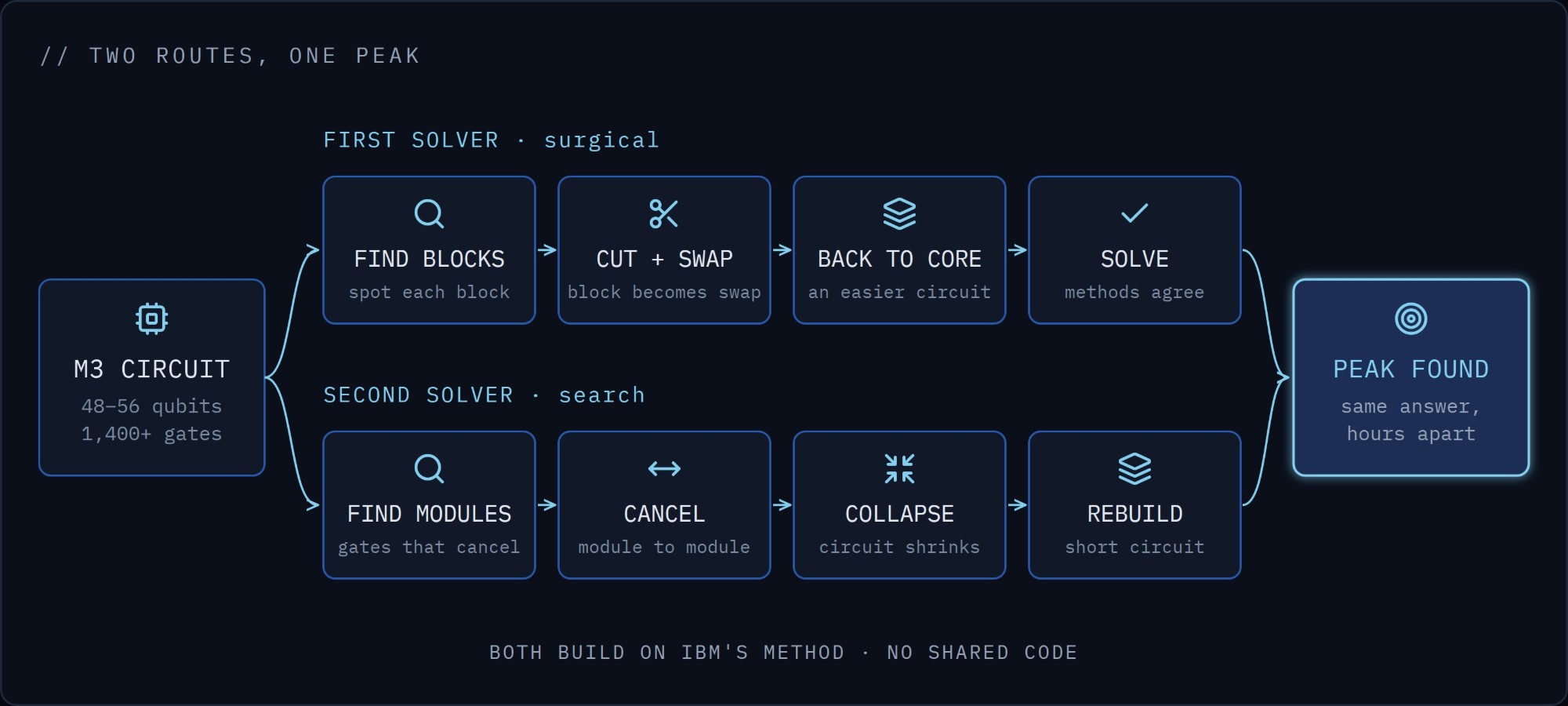
The two share no code, arriving at their solutions independently of one another. And as far as we can tell, neither technique appears in the published literature, meaning they've each discovered new attack vectors for BlueQubit to design against in Milestone 4.
"Putting our circuits in front of the world to solve classically is the most honest test we could ask for. Milestone 3 was the hardest construction we've put in front of Enigma, and it held for three months against some very formidable researchers. Watching it fall to two independent methods showed us exactly what we need to do to harden Milestone 4." — Hayk Tepanyan, CTO, BlueQubit
Each solution runs more than 10,000 lines of code. This is how the open model is supposed to work: published research and past winning solutions became the starting point, and now both of these solutions will be published as the starting point for the next attempt.
Why This Matters
For quantum computing: Milestone 3 is a real-world data point on an open research question. The added obfuscation made these circuits meaningfully harder to crack, but they still ultimately fell to clever algorithms that could run in four hours on a single GPU without internet access.
That's the kind of hard, public evidence the field needs before trusting any test of quantum advantage.
For Enigma: This result shows the whole model working.
- The market set the price: The prize started at $10,000 and grew the longer the milestone went unsolved. At $27,500, it got solved.
- The prizes are attracting serious work: The prize pools are doing what they're meant to do: drawing in substantial, independent solutions to a problem a leading research group designed to be hard.
- The IP portfolio grew by two: Winning solutions are published under an open-source license that requires anyone building on them commercially to open-source their own work too unless they license the solution from qBitTensor Labs. We've already seen interest from a quantum company in the IP from this milestone.
- It compounds: Milestone 4 will build directly off these solutions, raising the bar for miners and challenging them to find completely new exploits.
What's Next
BlueQubit is preparing the Milestone 4 circuits now, informed by everything Milestone 3 taught us. It's coming soon.
If you're a quantum or tensor-network researcher who read this and thought "I'd have done it differently," good. Both solutions will be published. Read them, beat them, and get paid for it.
Break today to build a better tomorrow.